A reusable elastic seal consists of a cylinder of material compressed between two flat surfaces.

Figure 1. An elastic seal. A good seal gives a large conforming contact-area without imposing damaging loads on itself or on the surfaces with which it mates
The seal must form the largest possible contact width, b, while keeping the contact stress, σ, sufficiently low that it does not damage the flat surfaces; and the seal itself must remain elastic so that it can be reused many times. What materials make good seals? Elastomers—everyone know that. But let us do the job properly; there may be more to be learnt.
Table 1 Design requirements for elastic seals
| Function | Elastic seal |
| Constraints | - Limit on contact pressure - Low cost |
| Objective | Maximum conformability to surface |
| Free variables | Choice of material |
The model. A cylinder of diameter 2R and modulus E, pressed on to a rigid flat surface by a force f per unit length, forms an elastic contact of width b where

The constraint: the seal must remain elastic, that is, σ must be less than the yield or failure strength, σf, of the material of which it is made. Combining the last two equations with this condition gives

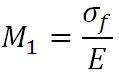
The contact width is maximized by maximizing the index

It is also required that the contact stress σ be kept low to avoid damage to the flat surfaces. Its value when the maximum contact force is applied (to give the biggest width) is simply σf, the failure strength of the seal. Suppose the flat surfaces are damaged by a stress of greater than 100 MPa. The contact pressure is kept below this by requiring that

The selection. The two indices are plotted on the σf-E chart in Figure 2 isolating elastomers, foams and cork. The candidates are listed

Figure 2 Materials for elastic seals. Elastomers, compliant polymers and foams make good seals
Table 2 Materials for reusable seals
| Material | M1 | Comment |
| Elastomeric EVA | 0.7–1 | The natural choice; poor resistance to heat and to some solvents |
| Polyurethanes | 2–5 | Widely used for seals |
| Silicone rubbers | 0.2–0.5 | Higher temperature capability than carbon-chain elastomers, chemically inert |
| PTFE | 0.05–0.1 | Expensive but chemically stable and with high temperature capability |
| Polyethylenes | 0.02–0.05 | Cheap but liable to take a permanent set |
| Polypropylenes | 0.2–0.04 | Cheap but liable to take a permanent set |
| Nylons | 0.02–0.03 | Near upper limit on contact pressure |
| Cork | 0.03–0.06 | Low contact stress, chemically stable |
| Polymer foams | up to 0.03 | Very low contact pressure; delicate seals |
in Table 2 with commentary. The value of M2=100MPa admits all elastomers as candidates. If M2 were reduced to 10 MPa, all but the most compliant elastomers are eliminated, and foamed polymers become the best bet.